Granite Switch in Mellea: one checkpoint, every adapter function
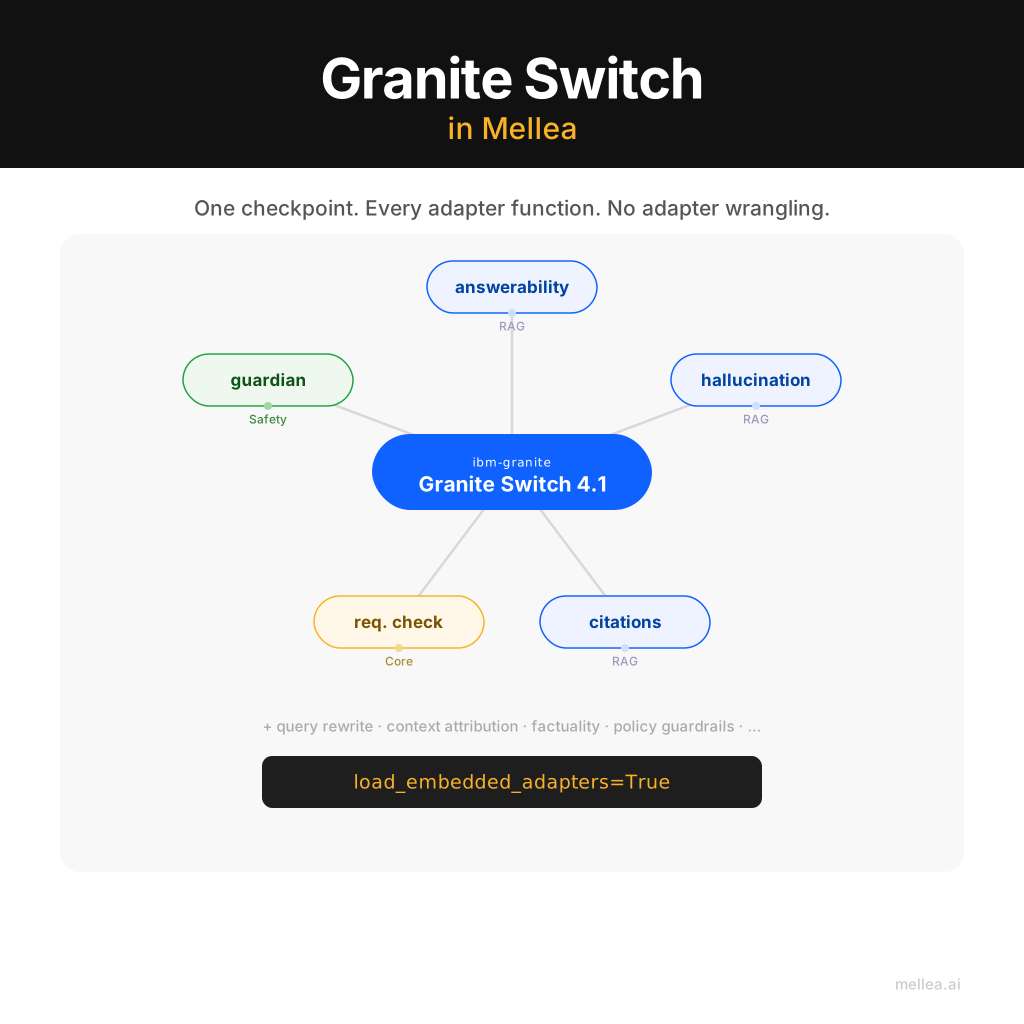
Imagine you're writing a Mellea program and the model has just produced a response. You want to validate it: is the answer grounded in the documents you retrieved? Does it satisfy the requirements you set? Is anything in the output hallucinated? Each of those checks would normally mean standing up a separate validation pipeline — a second model call with a tuned prompt, an LLM-as-judge harness, sometimes a classifier you trained yourself.
Granite Switch makes every one of those validations a single function call against the backend you're already using:
from mellea.stdlib.components.intrinsic import rag, core

rag.check_answerability(question, documents, context, backend)
rag.flag_hallucinated_content(response, documents, context, backend)
core.requirement_check(context, backend, requirement)
Same shape every time — swap the function name, get a different validation. One Granite Switch checkpoint serves a dozen of these: answerability, hallucination detection, requirement checks, citations, query rewriting, and more. Adding a validation step to your program is a code change, not an infrastructure change.
What you'll need: The
granite-switchplugin, vLLM on a GPU server with--enable-prefix-caching, andpip install "mellea[switch]"(see setup below). The client code runs on macOS or Linux. All snippets are in the mellea repo atdocs/examples/granite-switch/.
How it works
Granite Switch is a single Granite 4.1 base model (ibm-granite/granite-switch-4.1-3b-preview, also 8B and 30B) with
a switching layer and a curated set of validation capabilities — called adapter functions — embedded in
the model weights, and crucially, the routing between them is baked in too.
This is the architectural shift that makes the simplicity above
possible. With LoRA hot-swap, an orchestration layer outside the model
loads the right adapter for each call. With LLM-as-judge, you write a
second prompt and run the model again. With Granite Switch, the model
already knows how to be every one of these validators; you just tell
it which one to be for this call.
That signal is a control token in the chat template, set by Mellea
when you call an adapter function in mellea.stdlib.components.intrinsic
(rag, core, or guardian). No second
model to run, no adapter hot-swap, no eval pipeline to orchestrate
around your program. You serve one Granite Switch checkpoint and pick the behaviour
you want.
The performance advantage goes beyond convenience. Standard LoRA hot-swap clears the KV cache on every adapter switch — multi-step pipelines that check answerability, then generate, then verify hallucinations have to recompute context from scratch at each step. Granite Switch uses activated LoRA (aLoRA), where the adapter only activates from the control token onward, so the base-model KV cache stays valid and reusable. Context carries forward across adapter function calls without recomputation, which matters when you're chaining several validators in a single request. The accuracy improvement is real too: on IFEval, prompting the base Granite 4.1 3B model for requirement checking achieves 51% balanced accuracy; the embedded requirement-check adapter reaches 84%.
Setting it up
Granite Switch requires vLLM for inference — it uses a custom
GraniteSwitchForCausalLM architecture that only vLLM supports, via the
granite-switch plugin. Without it,
vLLM refuses to load the model with
Model architectures ['GraniteSwitchForCausalLM'] are not supported.
The client code runs on macOS or Linux.
Install the granite-switch plugin in your vLLM server environment:
pip install "granite-switch[vllm]"
Then start the model with prefix caching enabled:
vllm serve ibm-granite/granite-switch-4.1-3b-preview --port 8000 \
  --dtype bfloat16 --enable-prefix-caching
No --trust-remote-code, no quantization flags, no custom chat template.
Install Mellea in your application environment:
pip install "mellea[switch]"
Running answerability and hallucination detection
Set up the backend, then call adapter functions against it:
from mellea.backends.model_ids import IBM_GRANITE_SWITCH_4_1_3B_PREVIEW
from mellea.backends.openai import OpenAIBackend
from mellea.formatters import TemplateFormatter
from mellea.stdlib.components import Document, Message
from mellea.stdlib.components.intrinsic import rag
from mellea.stdlib.context import ChatContext

MODEL = IBM_GRANITE_SWITCH_4_1_3B_PREVIEW.hf_model_name
backend = OpenAIBackend(
    model_id=MODEL,
    formatter=TemplateFormatter(model_id=MODEL),
    base_url="http://localhost:8000/v1",
    api_key="EMPTY",  # a local vLLM server doesn't validate API keys — any string works
    load_embedded_adapters=True,
)
The load_embedded_adapters=True flag tells Mellea to fetch the adapter I/O configuration
files (a few kilobytes of JSON and YAML) from the Hugging Face model repo; the adapter
weights themselves are already built into the served checkpoint.
Now run answerability:
context = ChatContext().add(Message("assistant", "How can I help you?"))
docs = [Document("The square root of 4 is 2.")]

print(rag.check_answerability("What is the square root of 4?", docs, context, backend))
print(rag.check_answerability("What is the capital of France?", docs, context, backend))
Output:
answerable
unanswerable
The same backend object runs hallucination detection without any change to the setup:
context = (
    ChatContext()
    .add(Message("assistant", "Hello there, how can I help you?"))
    .add(Message("user", "Tell me about some yellow fish."))
)
response = "Purple bumble fish are yellow. Green bumble fish are also yellow."
documents = [Document("The only type of fish that is yellow is the purple bumble fish.")]

flagged = rag.flag_hallucinated_content(response, documents, context, backend)
for sentence in flagged:
    print(f"{sentence['faithfulness']:12}  {sentence['response_text']}")
Output:
faithful      Purple bumble fish are yellow.
unfaithful    Green bumble fish are also yellow.
Two sentences, two verdicts. The record for each sentence includes faithfulness,
response_text, character offsets, and a brief explanation from the model.
Nothing in the calling code changes depending on which
adapter function you're running.
When this fits
Granite Switch is the right choice when your program chains several validation
steps — answerability, hallucination detection, requirement checking — and you
want them all against one checkpoint with KV cache reuse between steps (enabled by
--enable-prefix-caching). The
alternative is a separate model call per validator. Model IDs are labelled
-preview — solid for prototyping and evaluation today.
For the full adapter surface, see the adapter functions
overview.
Try it
- Mellea: generative-computing/mellea — repo, issues, releases
- Examples:
docs/examples/granite-switch/— runnable examples for answerability, hallucination detection, and manual adapter loading - Docs: Intrinsics with Granite Switch in the OpenAI backend reference, and the adapter functions overview for the full capability surface
- Model card:
ibm-granite/granite-switch-4.1-3b-preview— architecture details and the full list of embedded adapters - Install:
pip install "granite-switch[vllm]"(server-side plugin),pip install "mellea[switch]"(client), thenvllm serve ibm-granite/granite-switch-4.1-3b-preview --port 8000 --dtype bfloat16 --enable-prefix-caching